2026 Top Medicine Glass Bottle Types for Global Buyers
Choosing the right Medicine Glass Bottle in 2026 requires more than comparing shapes, prices, and catalogue photos. Global buyers must examine chemical resistance, hydrolytic performance, light protection, closure compatibility, and filling-line efficiency. A bottle may look flawless under warehouse lighting, yet fail when exposed to sensitive formulations, temperature changes, or repeated transport vibration.
This guide introduces the leading Medicine Glass Bottle types for international pharmaceutical supply chains. It covers Type I borosilicate glass, Type II treated soda-lime glass, and Type III soda-lime glass. Amber, clear, molded, and tubular formats each serve different product needs. The details matter. A narrow-neck bottle can reduce dosing errors. Amber glass can shield light-sensitive liquids. A precise shoulder design may improve label placement and automated handling.
Dr. Arun K. Varshneya, a recognized glass-science expert, has emphasized, “Glass is a remarkable material because its composition can be tailored for demanding applications.” That principle remains important for pharmaceutical packaging. Bottle selection should follow the medicine’s formulation, not fashion or habit.
Quality documentation is equally important. Buyers should request material specifications, dimensional tolerances, extractables data, inspection records, and batch traceability. Regional standards can also differ. A practical decision may still need revision after stability testing. That is normal.
Not every popular bottle fits every market.
Small details protect trust.
The following sections compare the main bottle types, their practical strengths, limitations, and purchasing considerations for reliable global sourcing.
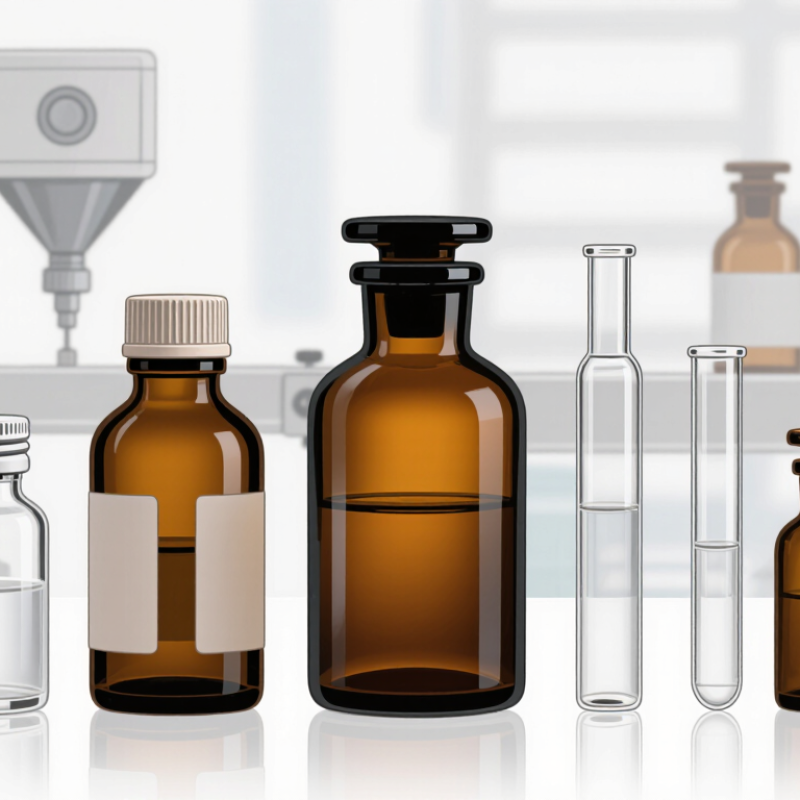
Medicine Glass Bottles: Purpose, Materials, and Essential Features
Medicine Glass Bottles: Purpose, Materials, and Essential Features
Medicine glass bottles protect liquid and solid medicines during storage, transport, and daily use. They help limit moisture, contamination, and chemical interaction. Amber glass can reduce light exposure for sensitive formulations. Clear glass supports easy visual inspection. However, clear glass may need secondary light protection.
Type I borosilicate glass offers strong chemical resistance and suits many demanding formulations. Type II treated soda-lime glass provides improved surface resistance for selected products. Type III soda-lime glass is practical for less sensitive medicines and dry contents. Material choice should follow formulation testing, filling conditions, and storage requirements. A perfect bottle does not exist. Some teams still choose by price alone, which can create avoidable risks.
Tips: Check hydrolytic resistance, wall thickness, neck dimensions, and closure compatibility before ordering. Review color consistency and inspect bottles for cracks, chips, bubbles, and sharp edges. Confirm whether the bottle supports sterilization, automated filling, and secure sealing. Request samples for compatibility and transport trials. Do not assume one specification fits every market. Global buyers should also verify packaging documentation and applicable local requirements with qualified technical professionals.
Glass Grades, Closures, and Compatibility Requirements
Selecting medicine glass bottles in 2026 starts with glass grade, not appearance. USP General Chapter <660> recognizes Type I borosilicate, Type II treated soda-lime, and Type III soda-lime containers. Type I provides the strongest hydrolytic resistance for many injectable products. Type II may suit aqueous formulations after surface treatment. Type III is often practical for dry products and less reactive medicines. The European Pharmacopoeia 11.0, section 3.2.1, applies comparable hydrolytic-resistance controls.
Closures require equal attention. Elastomer composition can affect extractables, adsorption, and container-closure integrity. USP General Chapters <381> and <382> address elastomeric components and functional suitability. ISO 15378:2017 also links pharmaceutical packaging production with risk-based quality controls. A screw cap, crimp seal, or child-resistant closure must match the filling process and storage conditions. Torque matters. So does liner compression. A closure that seals water may fail with volatile solvents or oily formulations.
Practical qualification should test the filled bottle, closure, and actual formulation together. Include transport vibration, sterilization, temperature cycling, and long-term stability. USP <660> testing alone cannot predict every drug interaction. That is an easy assumption to miss. Clear glass is not automatically safer. Procurement teams should request extractables data, dimensional drawings, closure specifications, and batch traceability before approval. Incomplete compatibility evidence should trigger another review, even when the bottle looks perfect.
Quality Standards, Regulations, and International Sourcing Factors
2026 Top Medicine Glass Bottle Types for Global Buyers
Medicine glass bottles are not interchangeable. Type I borosilicate glass suits injectables and sensitive formulations because it offers strong hydrolytic resistance and low ion release. Type III soda-lime glass often fits dry tablets, capsules, and non-aqueous products. Amber glass helps protect light-sensitive medicines. Tubular bottles support precise dimensions, while molded bottles can reduce unit costs for high-volume orders.
Quality begins with documented testing. USP-NF Chapter <660> and European Pharmacopoeia 3.2.1 address glass hydrolytic resistance. ISO 15378 adds quality-system expectations for primary pharmaceutical packaging. Buyers should request batch-specific certificates, dimensional reports, visual inspection data, and extractables evaluations. Check the neck finish carefully. A small mismatch can damage the seal or create leakage during transport. It happens.
Regulatory alignment also depends on destination markets. The WHO’s 2023 fact sheet reports that about one in ten medicines in low- and middle-income countries may be substandard or falsified, showing why packaging controls matter. International sourcing requires supplier audits, change-notification rules, traceability, and controlled storage records. Ask how bottles are packed against dust, moisture, and breakage. Review transport simulations for hot, humid routes. No test plan is perfect. A specification may overlook closure interaction, label adhesion, or temperature shock. Buyers should combine laboratory evidence with production-site experience, independent inspection, and periodic requalification.
2026 Top Medicine Glass Bottle Types for Global Buyers
Typical linear thermal expansion coefficients help indicate the thermal-shock behavior of pharmaceutical glass containers. Lower values generally support better resistance to rapid temperature changes. Final selection should also verify hydrolytic resistance and applicable pharmacopeial requirements.
Quality and sourcing note: Type I borosilicate glass is commonly selected for injectable and sensitive formulations because of its high chemical resistance. Type II treated soda-lime glass is used when improved surface hydrolytic resistance is required, while Type III soda-lime glass is typically used for less-sensitive oral and topical products. Buyers should check USP <660>, Ph. Eur. 3.2.1, ISO 4802, container closure integrity, sterilization compatibility, and destination-market regulations.