


NEWS at Quanex
See the latest news, posts and events from Quanex about our business, the industry, our people and more.
Top 10 Commercial Glass Door Types for Global Buyers
Choosing the right commercial glass door affects safety, traffic flow, energy use, and the customer’s first impression. This guide introduces ten widely used commercial glass door types for global buyers, from frameless entry systems to automatic sliding and revolving doors. Each option serves a different operating environment.
A busy supermarket may need a sensor-operated sliding door with strong daily-cycle performance. A boutique hotel may prefer a slim framed pivot door with low-iron glass. Offices often balance acoustic control, security hardware, and natural light. These details matter more than appearance alone.
The comparison considers glass construction, frame materials, opening methods, maintenance, accessibility, and installation conditions. Tempered glass offers impact resistance, while laminated glass can retain fragments after breakage. However, product performance depends on thickness, fittings, manufacturing quality, and correct installation. Specifications should be checked carefully.
Regional requirements also vary. Fire ratings, safety markings, wind loads, accessibility rules, and energy standards may differ between countries. Buyers should request test reports, warranty terms, replacement-part availability, and clear installation guidance. A low purchase price can become expensive when rollers, closers, or sensors fail early.
There is no perfect door.
This list is practical, not absolute. A door that works well in a climate-controlled office may perform poorly near a humid coastal entrance. Some designs also look elegant but create cleaning challenges around tracks and seals. By comparing real-use conditions with technical data, global buyers can make a safer, more durable, and better-informed decision.
What Defines a Commercial Glass Door and Its Main Applications
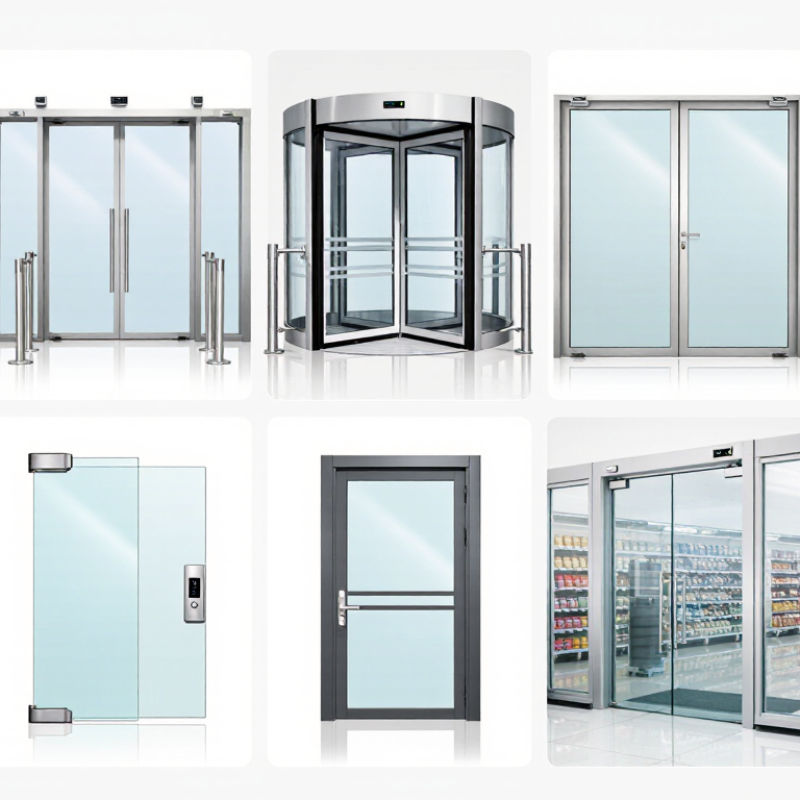
A commercial glass door is an entrance system designed for business environments, not simply a glass panel with hinges. It normally combines safety glass, a frame or patch fitting, hinges, locks, closers, and seals. Tempered glass resists impact, while laminated glass helps retain fragments after breakage. The correct choice depends on traffic, opening size, security needs, energy performance, and local building requirements.
The ten common types include storefront, frameless, pivot, sliding, automatic, revolving, folding, fire-rated, acoustic, and security glass doors. Each serves a different setting. Storefront doors suit retail entrances with frequent customer movement. Automatic sliding doors support hospitals, airports, and supermarkets. Revolving doors help manage busy lobbies and indoor air movement. Pivot doors create wide openings in offices, showrooms, and hospitality spaces. Folding systems work well where floor space is limited.
Details matter more than appearance. A busy entrance may need heavy-duty closers, low-energy automation, and visible safety markings. A hotel lobby may prioritize acoustics and a refined finish. In coastal areas, corrosion-resistant hardware deserves attention. Experienced buyers also check drainage, threshold height, cleaning access, and replacement lead times. A beautiful frameless door can perform poorly if its hinges are undersized. That mistake is easy to make. Specifications should be reviewed with the project engineer, installer, and local authority because accessibility, fire separation, and safety rules vary by region. The category name alone never proves suitability.
Top 10 Commercial Glass Door Types for Global Buyers - What Defines a Commercial Glass Door and Its Main Applications
| No. | Commercial Glass Door Type | Operating Method | Common Glazing | Typical Single-Leaf Width | Defining Characteristics | Main Commercial Applications |
|---|---|---|---|---|---|---|
| 1 | Framed Glass Swing Door | Single or double hinged leaves; manual or electronically controlled | Tempered safety glass, laminated glass or insulating glass units | 800–1,100 mm | Aluminum or steel framing provides structural support, weather sealing and hardware integration. | Office entrances, schools, clinics, retail stores, hotels and internal commercial partitions |
| 2 | Frameless Glass Swing Door | Hinged or patch-fitted manual operation | Tempered monolithic glass, commonly 10–12 mm thick | 750–1,000 mm | Minimal visible framing creates a transparent appearance; requires compatible floor, patch and overhead hardware. | Corporate offices, showrooms, reception areas, restaurants and premium interior spaces |
| 3 | Automatic Sliding Glass Door | Motorized one-way or bi-parting sliding movement, activated by sensors or access controls | Tempered or laminated safety glass; insulated glass for exterior envelopes | 900–1,500 mm per moving leaf | Supports hands-free access and high traffic flow; requires power, sensors, control equipment and safety monitoring. | Shopping centers, airports, hospitals, supermarkets, office buildings and public facilities |
| 4 | Manual Sliding Glass Door | Top-hung or floor-guided sliding movement | Tempered or laminated safety glass | 800–1,200 mm per panel | Needs less swing clearance than a hinged door and can be configured as a single, double or telescopic system. | Retail interiors, meeting rooms, hospitality venues, commercial apartments and office partitions |
| 5 | Automatic Revolving Glass Door | Motor-driven rotating wings around a central axis | Tempered or laminated safety glass in framed door wings | Overall diameter typically 2,000–4,000 mm | Controls pedestrian flow and can reduce direct air exchange between indoor and outdoor areas; requires sufficient lobby space. | Hotels, banks, corporate headquarters, airports and large commercial entrances |
| 6 | Storefront Glass Entrance Door | Usually center-hung, butt-hinged or pivoted within a storefront framing system | Tempered safety glass or laminated safety glass | 900–1,200 mm | Designed to coordinate with adjacent glazed storefront panels, mullions, transoms and commercial door hardware. | Ground-floor retail, restaurants, pharmacies, banks and mixed-use developments |
| 7 | Pivot Glass Door | Door leaf rotates on floor and overhead pivot points | Tempered, laminated or insulated safety glass, depending on location | 1,000–1,800 mm | Suitable for larger and heavier leaves than many conventional hinged systems; requires accurate structural coordination. | Flagship retail entrances, galleries, hotels, offices and architectural feature entrances |
| 8 | Fire-Rated Glass Door | Typically hinged; may be supplied as a single or double leaf in a tested assembly | Special fire-rated glass with certified framing, seals and hardware | 800–1,200 mm per leaf | Fire resistance is determined by the complete tested door assembly, not by the glass alone; certification is jurisdiction-specific. | Stairwells, corridors, fire compartments, hospitals, schools and high-rise buildings |
| 9 | Acoustic Glass Door | Hinged or sliding operation with compression seals and specialized frames | Laminated acoustic glass or double-glazed acoustic units | 800–1,200 mm per leaf | Sound reduction depends on the complete door set, including glass thickness, seals, frame, threshold and installation quality. | Conference rooms, recording facilities, executive offices, classrooms and medical consultation rooms |
| 10 | Security Glass Door | Manual or access-controlled hinged, sliding or revolving operation | Laminated security glass, multilayer glazing or tested forced-entry glass | 800–1,200 mm per leaf | Provides enhanced resistance to impact or forced entry when used with compatible frames, locks and access-control components. | Financial facilities, jewelry stores, pharmacies, data centers, public-service buildings and secure offices |
Related Posts
-

Why Choosing the Right Commercial Glass Door Can Transform Your Business Presence
-
7 Essential Tips for Choosing the Perfect Patio Glass Doors for Your Home
-
Top 10 Commercial Windows and Doors in China for Global Buyers?
-

Top 10 Window Screen Hardware Suppliers in China for Global Buyers?
-
Why Choose Sliding Door Security Screens for Your Home Safety?
-
Best Screen Door Frame Trends at the 139th Canton Fair?