
NEWS at Quanex
See the latest news, posts and events from Quanex about our business, the industry, our people and more.
What Are the Top Flag Pole Types for Global Buyers?
Choosing the right Flag Pole for international projects requires more than comparing height and price. Buyers should match the pole with climate, installation method, flag size, and maintenance capacity. A coastal hotel may need corrosion-resistant aluminum, while a windy inland school may prefer fiberglass flexibility. These choices affect shipping volume, foundation depth, installation time, and long-term appearance. Small details matter.
In practical sourcing work, several types regularly serve global buyers. Telescoping Flag Pole models suit temporary displays, events, and locations needing simple setup. Sectional aluminum poles can reduce transport costs and support taller installations. One-piece, in-ground poles often provide a cleaner appearance for commercial properties. Fiberglass options resist corrosion and offer visible flex during strong winds. Portable base systems work well for exhibitions, but they may feel unstable on uneven ground. No single type wins everywhere.
Reliable selection depends on verified specifications. Buyers should request material grades, wall thickness, wind ratings, hardware details, packing dimensions, and installation drawings. Local building, safety, and planning requirements should also be checked before purchase. Supplier certificates help, but they do not replace site assessment. That point is easy to overlook. I have seen attractive poles fail commercially because replacement parts were unavailable or the foundation instructions were vague. A careful comparison should include lifecycle cost, not only the initial quotation. The best Flag Pole is the one that fits the site, shipping route, weather exposure, and service expectations without creating avoidable maintenance problems. Even experienced buyers should leave room for review, because project conditions rarely match the catalogue perfectly.
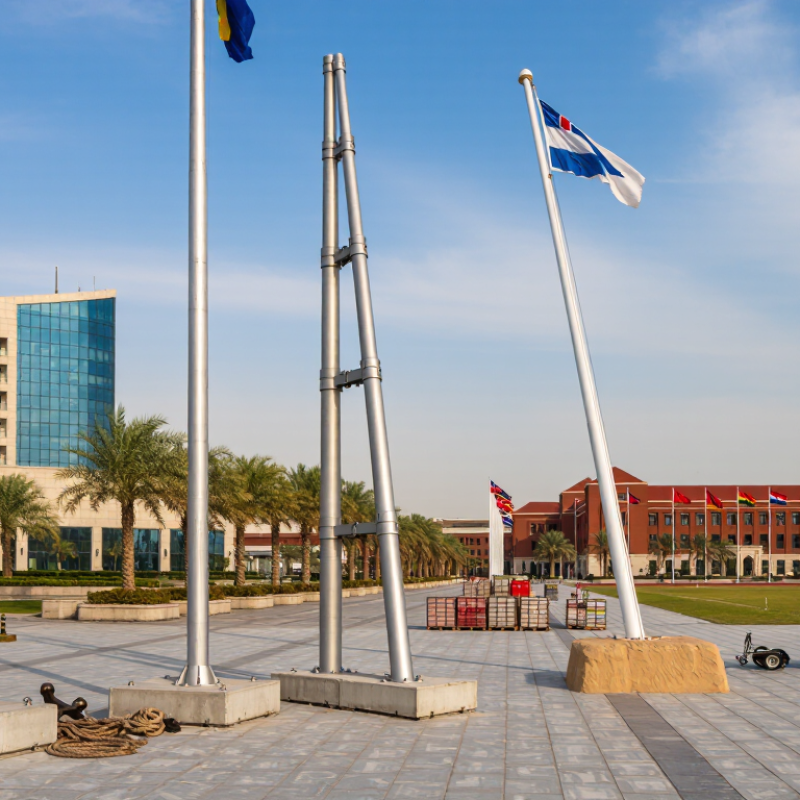
Flag Pole Types and Their Basic Structures
Flag poles vary mainly by installation method, material, and lifting system. A ground-set pole uses a buried sleeve, concrete foundation, shaft, pulley, halyard, and finial. It suits civic spaces and commercial sites. A hinged-base pole adds a base plate and pivot bolts. This structure allows safer lowering during maintenance, but it needs accurate anchoring.
Telescoping poles use overlapping sections with internal locks. They usually avoid external halyards and create a cleaner appearance. Sectional poles connect several shaft pieces with internal sleeves. They are easier to transport, although every joint requires careful inspection. Wall-mounted poles use brackets, bolts, and a short shaft. They work well on buildings, but masonry strength often matters more than pole diameter.
Material selection changes the basic structure. Aluminum offers low weight and easy handling. Steel provides greater stiffness, especially for taller poles, but requires durable corrosion protection. The World Steel Association reported about 1.89 billion tonnes of crude steel production in 2023, supporting broad global availability for structural components. However, supply volume does not prove outdoor performance.
Wind design remains critical. ASCE 7-22 and Eurocode EN 1991-1-4 direct designers toward site wind speed, exposure, height, and dynamic effects. A 2024 technical review from the International Association for Wind Engineering also emphasizes local turbulence around buildings. This detail is easy to miss. A taller pole is not automatically better. Foundation depth, soil bearing capacity, flag area, and hardware strength must work together. In practice, an attractive design can still fail if its foundation assumptions are too optimistic.
Key Materials Used in Modern Flag Poles
What Are the Top Flag Pole Types for Global Buyers?
Key Materials Used in Modern Flag Poles
Material choice shapes a flag pole’s strength, weight, lifespan, and maintenance needs. Aluminum is widely used because it is light, corrosion-resistant, and easy to transport. Its smooth surface also supports anodizing or powder coating. However, thin aluminum sections may flex noticeably in strong wind. Buyers should check wall thickness and wind-load data, not just the finish.
Steel offers higher rigidity for tall poles and demanding outdoor sites. Galvanized steel protects the surface with a zinc layer, while stainless steel performs well near humid or coastal environments. Steel poles need careful inspection around welds, bolts, and drainage points. Small rust spots can expand beneath damaged coatings. That detail is easy to miss. Fiberglass provides another practical option. It resists moisture, does not rust, and can reduce electrical conductivity concerns near certain installations. Yet ultraviolet exposure may fade its surface, and impact damage can be difficult to detect.
Timber flag poles create a warmer, traditional appearance and suit parks, schools, and heritage properties. Durable timber requires sealing, regular checks, and protection from ground moisture. Carbon-fiber poles are lighter and exceptionally stiff, but their cost and repair requirements limit broader use. In real projects, the best material is rarely the strongest one. Soil conditions, pole height, local weather records, shipping limits, and maintenance skills all matter. A polished specification can still fail when installers overlook foundations or underestimate fabric drag.
What Are the Top Flag Pole Types for Global Buyers? - Key Materials Used in Modern Flag Poles
| Flag Pole Type | Primary Materials | Typical Height Range | Main Advantages | Limitations | Typical Applications | Maintenance Level | Relative Cost |
|---|---|---|---|---|---|---|---|
| Aluminum Flag Pole | Extruded aluminum alloy, stainless steel fittings, and protective powder coating or anodized finish | 3–15 m (10–49 ft) | Lightweight, naturally corrosion-resistant, easy to transport, and suitable for many climates | Can dent under severe impact; thinner sections may require additional reinforcement in high-wind locations | Commercial buildings, schools, public facilities, residential properties, and portable display systems | Low Periodic cleaning and hardware inspection | Low to medium |
| Stainless Steel Flag Pole | Stainless steel tubing, stainless steel cables, cast or machined metal fittings | 3–12 m (10–39 ft) | High strength, premium appearance, good resistance to moisture and staining, and strong hardware durability | Heavier than aluminum; surface quality depends on the stainless-steel grade and finishing process | Modern commercial buildings, coastal facilities, government sites, and architectural installations | Low to medium Cleaning helps prevent salt deposits and surface staining | Medium to high |
| Galvanized Steel Flag Pole | Structural steel with a zinc coating, often combined with galvanized or stainless steel fittings | 6–30 m (20–98 ft) | High structural strength, suitable for large flags and taller fixed installations, and widely available | Heavy, more difficult to install, and vulnerable to corrosion if the zinc coating is damaged | Industrial sites, sports grounds, municipal areas, and large commercial properties | Medium Inspect coating, base, fasteners, and drainage points | Medium |
| Fiberglass Flag Pole | Glass fibers embedded in a polymer resin, with gel-coat or painted outer surfaces | 3–15 m (10–49 ft) | Lightweight, electrically nonconductive, resistant to many chemicals, and available in low-glare finishes | Can fade, crack, or become brittle after long-term ultraviolet exposure or severe impact | Residential areas, schools, coastal locations, resorts, and decorative installations | Low Check for surface cracks, fading, and hardware wear | Medium |
| Carbon-Fiber Flag Pole | Carbon fibers in an epoxy resin matrix, usually with aluminum or stainless steel fittings | 2–10 m (7–33 ft) | Very low weight, high stiffness-to-weight ratio, fast deployment, and strong portability | Higher purchase cost; localized impact can damage the composite even when surface damage is limited | Professional events, marine applications, transportable displays, and performance-oriented systems | Low to medium Protect against impact and inspect composite sections | High |
| Wooden Flag Pole | Pressure-treated timber or naturally durable wood, exterior stain or paint, and metal fittings | 3–12 m (10–39 ft) | Traditional appearance, renewable material options, and easy visual integration with heritage architecture | Requires protection from moisture, insects, fungal decay, splitting, and ultraviolet exposure | Historic properties, parks, residential settings, rural sites, and decorative applications | High Regular sealing, painting, and inspection are normally required | Medium |
| Telescoping Flag Pole | Usually aluminum or fiberglass sections with locking collars and corrosion-resistant hardware | 2–9 m (7–30 ft) | Quick setup, compact storage, adjustable height, and no permanent multi-section assembly in many models | Locking mechanisms require inspection; maximum flag size and wind performance are usually more limited | Temporary events, travel use, exhibitions, construction sites, and residential displays | Low to medium Clean and inspect collars, joints, and locking parts | Low to medium |
| Internal-Halyard Flag Pole | Aluminum, stainless steel, or galvanized steel shaft with internal cable, pulley, and locking hardware | 6–30 m (20–98 ft) | Reduces exterior rope noise, improves security, and presents a clean appearance | Internal components are less accessible and may require specialized servicing | Corporate facilities, civic buildings, schools, airports, and high-security locations | Medium Inspect cable, pulley, truck assembly, and locking system | Medium to high |
| External-Halyard Flag Pole | Commonly aluminum, galvanized steel, or fiberglass with exterior rope, pulley, and cleat | 3–24 m (10–79 ft) | Simple operating design, accessible rope system, easy flag replacement, and broad compatibility | Rope is exposed to weather and may create noise; the cleat can be accessible without added security measures | Residential properties, schools, community areas, and general commercial installations | Medium Replace worn rope and inspect pulley and cleat condition | Low to medium |
| Wall-Mounted Flag Pole | Aluminum, stainless steel, steel, or fiberglass pole with a metal wall bracket | 0.6–3 m (2–10 ft) | Requires minimal ground space, offers simple installation, and works well for building-front displays | Limited flag size and exposure area; wall structure and bracket anchoring must support the applied loads | Retail storefronts, balconies, offices, restaurants, and residential buildings | Low Inspect bracket fasteners and pole-to-bracket connections | Low |
| Solar-Lit Flag Pole | Aluminum, steel, or fiberglass shaft combined with photovoltaic panels, rechargeable batteries, and LED lighting | 6–15 m (20–49 ft) | Supports nighttime flag visibility without direct mains wiring and can reduce installation trenching | Performance depends on sunlight, battery life, weather sealing, and periodic electrical component replacement | Commercial entrances, public spaces, remote facilities, and locations requiring overnight visibility | Medium Clean solar panels and check batteries, seals, and LED components | Medium to high |
Note: Height ranges and relative costs are typical market guidelines. Final specifications should be selected according to flag dimensions, local wind conditions, foundation design, installation regulations, and the required safety factor.
Comparing Permanent, Portable, and Telescoping Flag Poles
Permanent, portable, and telescoping flag poles serve different buying conditions. Grand View Research valued the global flags market at approximately US$1.7 billion in 2023. Its report also forecasts steady growth through 2030, supported by institutional, commercial, and promotional demand. Permanent poles suit government sites, schools, factories, and hotels. Their buried sleeves or concrete foundations provide stronger stability. However, installation requires soil checks, lifting equipment, drainage planning, and wind calculations. ASCE 7-22 requires structural designs to consider site wind speed and exposure. A tall pole is not automatically a safer pole.
Portable poles reduce installation time. They work well for exhibitions, ceremonies, sports grounds, and temporary roadside displays. Their weighted bases should match pole height, fabric area, and expected wind. Water-filled bases are convenient, but they can become unstable after leakage or freezing. Sandbags help, though they look less refined. Real-world setup often exposes this weakness. Portable systems are easy to move, but frequent transport can damage joints and base fittings.
Telescoping poles offer the most compact storage. Their nested sections can fit inside vehicles and deploy without cranes. They suit mobile teams, property inspections, seasonal campaigns, and emergency communications. Buyers should check locking mechanisms, tube overlap, corrosion resistance, and replacement-part availability. Lightweight aluminum improves handling, but excessive thinness may reduce rigidity. No option is perfect. A permanent pole can be overbuilt, while a portable pole can be underweighted. Careful wind assessment and honest maintenance planning matter more than appearance alone.
Choosing Flag Poles for Different Environments and Uses
What Are the Top Flag Pole Types for Global Buyers?
Choosing Flag Poles for Different Environments and Uses
Flag poles should match the environment, not just the flag size. Aluminum poles are lightweight and resist rust, making them practical for schools, offices, and moderate coastal areas. Fiberglass poles offer flexibility and stable color performance under strong sunlight. Steel poles provide greater rigidity for tall installations, but they need protective coatings and regular inspections. In windy regions, review the pole’s wind rating, wall thickness, foundation depth, and hardware quality. A beautiful pole can still fail if the base is poorly engineered.
Tips: Measure the site before ordering. Check soil conditions, drainage, nearby trees, and overhead clearance. For coastal locations, choose corrosion-resistant fittings and rinse exposed parts periodically. Telescoping poles suit temporary displays and events because they store easily. Internal halyard systems create a cleaner appearance and reduce rope movement, while external halyards are simpler to inspect and repair.
Use ground-set poles for permanent public or commercial spaces. Hinged-base models can help maintenance teams lower the pole safely, especially where equipment access is limited. Wall-mounted poles work well on narrow streets, balconies, and building entrances, but the wall must carry the load. Local weather data matters more than general product descriptions. Some specifications look convincing. They may still overlook sudden gusts, unstable soil, or installation errors. A qualified installer should verify the foundation and anchoring details before final placement.
Global Buyer Considerations: Standards, Shipping, and Maintenance
For global buyers, the best flag pole type depends on wind exposure, shipping limits, and maintenance access. Aluminum poles are light and economical; fiberglass resists corrosion, while steel suits larger, high-load installations. Telescoping designs reduce packing volume, but their joints need careful inspection after repeated deployment. UNCTAD’s Review of Maritime Transport 2023 reports that over 80% of global merchandise trade by volume moves by sea. Shipping changes the calculation.
Ask suppliers for structural calculations based on the installation site, not generic wind claims. ASCE 7-22 and EN 1991-1-4 provide recognized approaches for wind-load design, but local authorities may require additional review. For coastal projects, ISO 12944 coating classifications help compare corrosion protection systems. Standards are not interchangeable. Confirm the required edition, testing method, and documentation before payment.
Maintenance planning should begin before the pole leaves the factory. The NACE IMPACT study estimated global corrosion costs at about 3.4% of world gross domestic product in 2013, while prevention could reduce losses by 15% to 35%. Specify sealed fittings, drainage paths, replaceable halyards, and compatible fasteners. Aluminum and stainless steel can develop galvanic corrosion without proper isolation. Packaging also matters; crushed sections are difficult to detect inside a wooden crate. A low purchase price may still hide labor, port storage, and replacement costs. Many comparisons overlook these details, and that weakness deserves more honest review.
